Molecular Insights
Fermented Rice Water Has Been Korea's Brightening Secret for Centuries. The Science Finally Caught Up.
Korean women have been washing their faces with rice water since the Joseon Dynasty. Now researchers know why it works — fermentation unlocks ferulic acid, inositol, and kojic acid that target uneven tone at the molecular level.
May 28, 2026 · 7 min read
Why Did Korean Women Wash Their Faces With Rice Water?
The practice dates back to the Joseon Dynasty (1392–1897), when court women (궁녀) would collect the milky water left over from rinsing rice before cooking. They used it as a daily face wash and hair rinse. The observation was simple: skin looked clearer and more luminous after consistent use. There was no lab to explain why — just centuries of pattern recognition.
Japan has a parallel tradition. Geisha in Kyoto famously rinsed with rice water, and sake brewery workers were known for having remarkably smooth hands despite harsh labor — a clue that eventually led researchers to study fermented rice bran in earnest.
What Happens When Rice Water Ferments — and Why Does It Matter?
Raw rice water is fine. Fermented rice water is where it gets interesting. When Lactobacillus and other microorganisms break down rice starch over 24–48 hours, they unlock compounds that weren't bioavailable before. The pH drops (becoming mildly acidic, closer to your skin's natural pH), and the concentration of active compounds increases significantly.
- Ferulic Acid
- A potent antioxidant that stays stable during fermentation and helps other antioxidants (like vitamin C and E) perform better
- Inositol
- A vitamin B8 compound that supports cell turnover and helps visibly refine pore appearance over 4–6 weeks of consistent use
- Kojic Acid
- A natural byproduct of fermentation — one of the most studied brightening compounds, often compared to hydroquinone but with a gentler profile
- γ-Oryzanol
- Unique to rice bran — an antioxidant that also helps reduce the appearance of dark spots by interfering with melanin production pathways
Can Rice-Based Skincare Really Even Out Your Skin Tone?
Yes — but patience is key. Rice-based brightening doesn't work overnight like a chemical peel. The mechanism is gentler: ferulic acid and gamma-oryzanol help manage melanin pathways over time, while kojic acid and lactic acid from fermentation assist in gradually revealing fresher skin underneath. Studies have shown measurable improvements in skin clarity after 4–6 weeks of consistent use.
The advantage over stronger brightening actives? Rice extract is remarkably well-tolerated. Unlike vitamin C serums (which oxidize) or high-dose niacinamide (which can cause flushing in some people), fermented rice products are gentle enough for daily use on sensitive skin. That's why they've become the entry-level brightening step in many Korean routines — the one you can use without worrying about irritation cycles.
What Are the Best Korean Rice Skincare Products Right Now?
- I'm From Rice Toner — The product that started the Korean rice toner trend. Made with rice extract from Yeoju, Gyeonggi Province — known for Korea's finest rice. Brightening, hydrating, and milky.
- Beauty of Joseon Glow Deep Serum — Rice + Alpha Arbutin — Rice water paired with alpha arbutin for a double approach to uneven tone. Lightweight, absorbs fast, layers well under sunscreen. Around 3 at Olive Young.
- SKINFOOD Rice Brightening Mask Wash Off — A wash-off mask with rice bran and rice extract. Provides gentle physical and enzymatic exfoliation while delivering gamma-oryzanol. A K-beauty classic that's been reformulated for 2026.
- Sulwhasoo First Care Activating Serum — Sulwhasoo's hero product uses JAUM Balancing Complex — a blend of fermented Korean botanicals including rice. Premium price, but decades of formulation heritage behind it.
For informational purposes only. Not intended as medical or professional advice.
발효 쌀뜨물, 수백 년간 이어진 한국의 피부 비법. 이제야 과학이 이유를 밝혔어요
조선시대 궁녀들은 밥 짓기 전에 남은 쌀뜨물로 세수했어요. 요즘 연구자들이 그 이유를 알아냈는데 — 발효 과정에서 페룰산(ferulic acid), 이노시톨(inositol), 코직산(kojic acid)이 풀려나와서 분자 단위로 피부톤 정돈에 도움을 줘요.
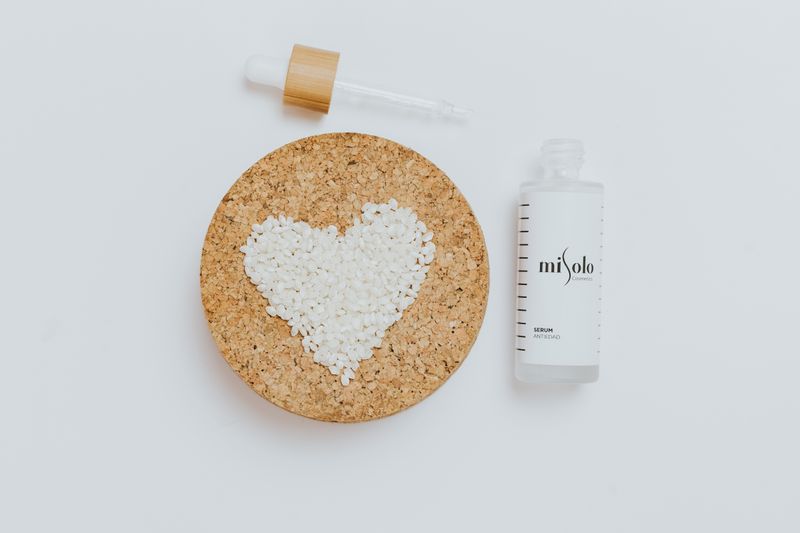
Flat lay of rice grains arranged in a heart shape beside a skincare serum bottle · Pexels 조선시대 여성들은 왜 쌀뜨물로 세수했을까요?
조선시대(1392~1897년)까지 거슬러 올라가는 관습이에요. 궁녀들이 밥을 짓기 전 쌀을 씻으면서 나오는 뿌연 물을 따로 모아서 세안수와 머릿결 헹굼수로 썼어요. 눈으로 확인할 수 있는 건 분명했어요 — 꾸준히 쓰면 피부가 한결 맑고 환해 보였거든요. 그 이유를 설명해 줄 실험실은 없었지만, 수백 년치 경험이 쌓여 있었어요.
일본에도 비슷한 전통이 있어요. 교토의 게이샤가 쌀뜨물로 세안한 건 유명하고, 사케 양조장에서 일하는 분들은 힘든 노동에도 손이 유달리 매끈했다고 해요. 이 단서가 연구자들이 발효 쌀겨를 본격적으로 파고드는 계기가 됐어요.
쌀뜨물이 발효되면 뭐가 달라지는 걸까요?
생(生) 쌀뜨물도 나쁘지 않아요. 하지만 진짜 재밌는 건 발효시킨 다음이에요. 유산균(Lactobacillus) 같은 미생물이 24~48시간에 걸쳐 쌀 전분을 분해하면, 원래는 그대로 쓸 수 없던 화합물이 활성 형태로 풀려나와요. pH는 낮아지면서(약산성으로, 피부 본래 pH에 가까워지면서) 활성 화합물의 농도가 확 올라가요.
- 페룰산(ferulic acid)
- 발효 중에도 안정적으로 유지되는 항산화 성분이에요. 비타민 C·E 같은 다른 항산화제가 더 잘 작동하도록 도와주는 역할도 해요
- 이노시톨(inositol)
- 비타민 B8 계열 화합물로 세포 턴오버를 도와줘요. 4~6주 꾸준히 쓰면 모공이 눈에 띄게 정돈되는 걸 볼 수 있어요
- 코직산(kojic acid)
- 발효 과정에서 자연스럽게 생기는 부산물이에요. 가장 많이 연구된 브라이트닝 성분 중 하나로, 하이드로퀴논과 비교되지만 훨씬 순한 편이에요
- 감마오리자놀(γ-oryzanol)
- 쌀겨에서만 발견되는 성분이에요. 멜라닌 생성 과정에 관여해서 다크스팟이 옅어지는 걸 도와주는 항산화 성분이에요
쌀 성분 스킨케어로 정말 피부톤이 고르게 될까요?
네 — 다만 시간이 좀 걸려요. 쌀 기반 브라이트닝은 화학 필링처럼 하룻밤에 뚝딱 효과가 나오는 타입이 아니에요. 페룰산과 감마오리자놀이 시간을 두고 멜라닌 경로를 관리해 주고, 발효 과정에서 생긴 코직산과 젖산이 묵은 각질을 서서히 걷어내면서 아래쪽 맑은 피부가 드러나요. 연구에 따르면 4~6주 꾸준히 쓰면 피부 투명도가 수치로 측정될 만큼 좋아져요.
더 강한 브라이트닝 성분과 비교했을 때 장점이 뭐냐면요? 쌀 추출물은 피부가 놀라울 정도로 잘 받아들여요. 산화가 잘 되는 비타민 C 세럼이나, 일부 사람에게 홍조를 유발할 수 있는 고농도 나이아신아마이드와 달리, 발효 쌀 제품은 민감 피부도 매일 부담 없이 쓸 수 있을 만큼 순해요. 그래서 많은 한국인 루틴에서 입문용 브라이트닝 단계로 자리잡았어요 — 자극 걱정 없이 쓸 수 있는 첫 번째 미백 제품이에요.
지금 주목할 만한 K-뷰티 쌀 스킨케어 제품
- I'm From Rice Toner — 한국 쌀 토너 트렌드를 연 시초 제품이에요. 경기도 여주 쌀 추출물로 만들었는데, 여주는 한국 최고 쌀 산지로 유명해요. 브라이트닝, 보습, 밀키한 텍스처가 특징이에요.
- Beauty of Joseon Glow Deep Serum — Rice + Alpha Arbutin — 쌀뜨물에 알파알부틴(alpha arbutin)을 더해서 피부톤 정돈에 이중으로 접근해요. 가볍고 흡수가 빨라서 선크림 아래 레이어링이 잘 돼요. 올리브영 기준 약 1만 7천 원이에요.
- SKINFOOD Rice Brightening Mask Wash Off — 쌀겨와 쌀 추출물이 들어간 워시오프 마스크예요. 감마오리자놀을 공급하면서 물리적·효소적으로 부드럽게 각질을 관리해 줘요. 2026년 리뉴얼 된 K-뷰티 클래식이에요.
- Sulwhasoo First Care Activating Serum — 설화수의 시그니처 제품이에요. 쌀을 포함한 발효 한방 성분을 블렌드한 자음밸런싱 콤플렉스가 핵심이에요. 프리미엄 가격이지만 수십 년 제형 헤리티지가 뒷받침하고 있어요.
본 콘텐츠는 정보를 제공하기 위한 것이며, 전문적인 의료 조언을 대신하지 않습니다.